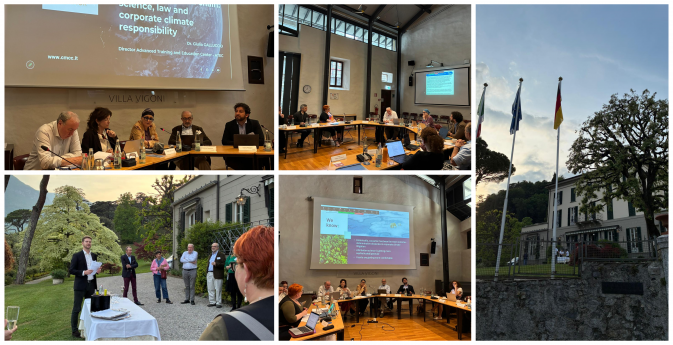
From 27–29 April 2026, Villa Vigoni on Lake Como hosted the interdisciplinary workshop “Forging the Causal Chain: Science, Law and Corporate Climate Responsibility”, organised within the framework of the MAGICA project by the CMCC Foundation's Advanced Training and Education Center (ATEC). The workshop brought together leading climate scientists, legal scholars, judges and litigation practitioners to explore one of the most challenging questions in climate governance: how can scientific evidence of climate change be translated into legally meaningful concepts of causation and responsibility?
Workshop programme can be seen here.
As climate litigation continues to expand worldwide, establishing robust causal links between greenhouse gas emissions, climate impacts and legal responsibility is becoming increasingly important. Yet significant gaps remain between advances in attribution science and the standards of proof required in legal settings. The workshop provided a unique space for participants to examine these challenges from both scientific and legal perspectives.
Across three days of highly interactive discussions, participants explored attribution and scientific causality, the construction of multi-step causal chains linking emissions to climate impacts and damages, and the ways in which advanced climate science can be operationalised within existing legal frameworks. Discussions were structured around concrete research questions and climate litigation case studies, encouraging dialogue across disciplinary boundaries and helping to identify unresolved questions for future research.
The workshop reflected MAGICA's broader ambition to strengthen connections between climate knowledge, governance and societal action. By fostering dialogue across disciplines and communities, initiatives such as this help ensure that emerging scientific knowledge can inform decision-making in policy, governance and legal contexts.