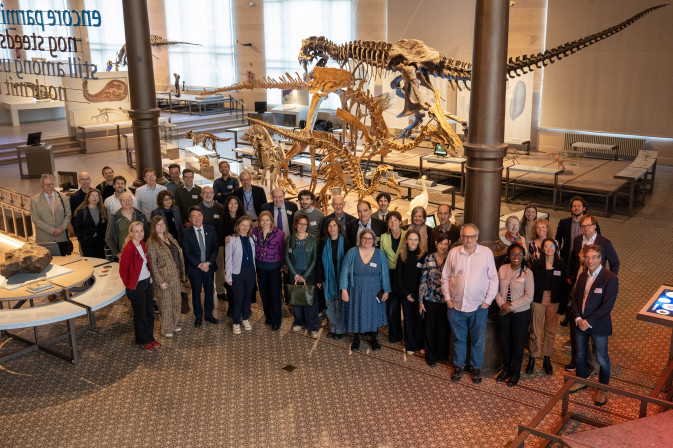
“We are in a climate change world and we can't do anything about that unless we have analyses of these changes” - Samantha Burgess, Deputy Director of the Copernicus ECMWF Climate Change Service (C3S), summed up the vital role of Earth observations during a busy day of presentations and knowledge exchange at the 'Equinox Stocktake: Global Climate Observation Systems'.
The first Equinox event focussing on monitoring impacts of climate change on Earth that can only be measured from space, took place at the Royal Belgian Institute of Natural Sciences on March 18 (2026). It set out to determine the current state of play of global climate observation systems and the threats to sustained observations of the globally agreed indicators of climate change impact, the Essential Climate Variables (ECVs). It also considered how the information is used by Parties to the UNFCCC and Paris Agreement as well as options to improve its utility to these processes.
The audience was drawn from across European policy and climate science. They heard from an impressive line-up of speakers representing leading organisations and institutions in satellite Earth Observation (EO), meteorology, climate science and EO data users, including the World Meteorological Organization (WMO), European Space Agency (ESA) and the Copernicus Climate Service (C3S).
Samantha Burgess was speaking on behalf of stakeholders in the afternoon session ‘Value of Earth Observation’. She added: “We need to adapt the narrative to policymakers to get the budget we need to do the observations we need, to get information that society desperately needs.”
Samantha also highlighted the widely growing call for returns on investment in Earth Observations.
Further insights in this session came from Albert Fischer of World Meteorological Organization, Heather Maseko-Msyale who is Programme Officer (Research, Science and Systematic Observations) at the UNFCCC Secretariat (UN Climate Change), Emma Woolliams of National Physical Laboratory (NPL) and Sarah Connors, Climate Applications Scientist, at the European Space Agency.
The role of Earth Observation in the science-policy interface, including at the levels of the UNFCCC, IPCC, the COP global climate summits and European Commission, was a theme that ran through the programme.
The day opened with an overview of GCOS – the Global Climate Observing System – founded in 1992 and responsible for assessing and improving climate observations, maintaining definitions of the ECVs that are the 55 globally agreed indicators of Earth’s environment and climate, 26 of which can only be monitored by satellites in space. GCOS currently only has funding until 2028.
Albert Fischer, Director of WMO, reported that funding from key GCOS donors has fallen and that without further action the programme will have to close in 2028, posing a threat to one of the most valuable aspects of Earth Observation: continuity and consistency of data. He emphasised the value of GCOS as the ‘power of a global, neutral voice… for a global public good’, adding that there is a proven need for collective action, strengthened global communication [of the environmental impacts of climate change] and more risk-based prioritisation.
The programme then moved to the first of four sessions: ‘State of Play: Observations Across the Domains (Weather, Climate, Composition)’ which explored gaps and emerging threats to global observations. The audience heard from speakers with expertise on Atmosphere (Peter Thorne, Professor of Physical Geography (Climate Science) and Director, ICARUS Climate Research Centre, Maynooth University, Ireland); Ocean (Sabrina Speich, Professor of Physical Oceanography and Climate Sciences at France’s École Normale Supérieure) and Claudia Giardino, Senior Research Scientist at the Institute for Electromagnetic Sensing of the Environment, Italian National Research Council.
The second session looked at key user applications that rely on observation data. Tina Christensen, Scientific Advisor at the Danish Meteorological Institute, who heads the Danish delegation at IPCC meetings, highlighted the role of EO in providing the trusted and reliable scientific data that underpins climate policy and strategies at global levels, adding: “It’s crucial that science and policy are saying the same things.”
Further insights came from:
- Valérie Masson-Delmotte – LSCE, Université Paris-Saclay, France
- Marie Cavitte – Postdoctoral Researcher, Department of Water & Climate, Vrije Universiteit Brussel
- Gerard van der Schrier – Royal Netherlands Meteorological Institute (KNMI)
From a commercial perspective, Maria de Fargo, Senior Consultant at Telespazio UK, spoke on behalf of Space4Climate, the membership organisation for the UK Earth Observation community. She used as an example of satellite EO-reliant applications a ground-breaking Horizon-funded initiative of which Telespazio UK was part: Nature-Demo, which integrates Nature-based Solutions (NbS) into the planning and development of climate-resilient infrastructures, and includes MonARIS, Telespazio UK’s infrastructure structural health suite of products.
Demonstrator projects were carried out in Lattenbach Valley, Austria, and Ljubljana, Slovenia, to develop the holistic approach to infrastructure resilience, addressing multiple environmental challenges simultaneously and promote the integration of NbS into resilience strategies and standards.
‘Opportunities and challenges for science, policy, research and innovation – Earth system cycles and trends’ were raised as Future Directions for GCOS were discussed in the third session, chaired by Sarah Connors of ESA. The speakers were Karina von Schuckmann of Mercator Ocean International, Matthias Zink of the Federal Institute of Hydrology, Germany, Peter Landschützer of the Flanders Marine Institute and Piers Forster from the University of Leeds, UK. This led to a roundtable discussion between Samantha Burgess of ECMWF, José Miguel Rubio-Iglesias of ESA and Stijn Nevens of Belgium’s Royal Meteorological Institute.
The afternoon moved on to the Stakeholder Responses sessions before concluding with Peter Thorne presenting ‘The Way Forward – A Business Case for GCOS’. He stated: “If GCOS did not exist, we would decide it was needed!”
Frank McGovern, Chief Climate Scientist at Ireland’s Environmental Protection Agency and Vice-Chair of JPI Climate, drew together the key messages of the day and next steps. He said the day of presentations and discussions had underlined the need for long-term, international investment in climate observations and their operational infrastructure. He noted the value of the global voice of the science, stakeholder and user communities, particularly through GCOS, and their aligned key messages. He called for messaging and observations to be set in the context of risk, resilience, and societal value and accord with policy priorities.
The Equinox Process – an initiative by JPI Climate and the Horizon-funded MAGICA Climate Project to accelerate climate science into policy action – will maintain the momentum developed through the event to strengthen coordination and ensure that climate observations effectively support decision-making. This will include publishing a Summary Report and feeding the outcomes into JPI Climate’s upcoming events and dialogues.
The next event is the Climate and Neutrality Forum, on May 28-29, in Brussels.